Last updated 2026-08-14
TL;DR
Most home gyms need one multi-function piece (a power rack with a pull-up bar and pulley option) plus free weights, not a room full of single-purpose machines. Budget $1,500 to $6,000 for a solid setup, more for a turnkey build with flooring and electrical work included. Start with a rack, a bench, plates, and a bar before adding anything else.
what machines actually matter for a home gym
Commercial gyms fill floor space with single-purpose machines because they need to move a lot of people through workouts fast, and machines reduce the coaching load per member. A home gym doesn't have that problem. You're training yourself, maybe a partner, and you have all the time in the world to learn a barbell squat instead of sitting in a leg press seat. The one machine category that earns its floor space in almost every home gym is a power rack (also called a squat rack or power cage). It's not a "machine" in the leg-press sense: it's a steel frame that holds a barbell safely at the top and bottom of a lift, with adjustable safety bars that catch the weight if you fail a rep. Everything else, cable pulley attachments, dip bars, landmine attachments, usually bolts onto the rack itself rather than taking up separate floor space. After the rack, the next tier of useful equipment is a cable machine or a rack-mounted pulley system, an adjustable bench, and a set of dumbbells or a loadable dumbbell system. True single-purpose machines (leg extension, leg curl, pec deck) are the last things to add, if you add them at all. They isolate one joint and take real floor space and money for a narrower training benefit than a rack and a bar. If you're deciding between a rack-centered setup and a machine-heavy one, read our comparison of a squat rack versus a full multi-station setup, and our broader guide to home gym equipment selection.
what is a power rack, exactly
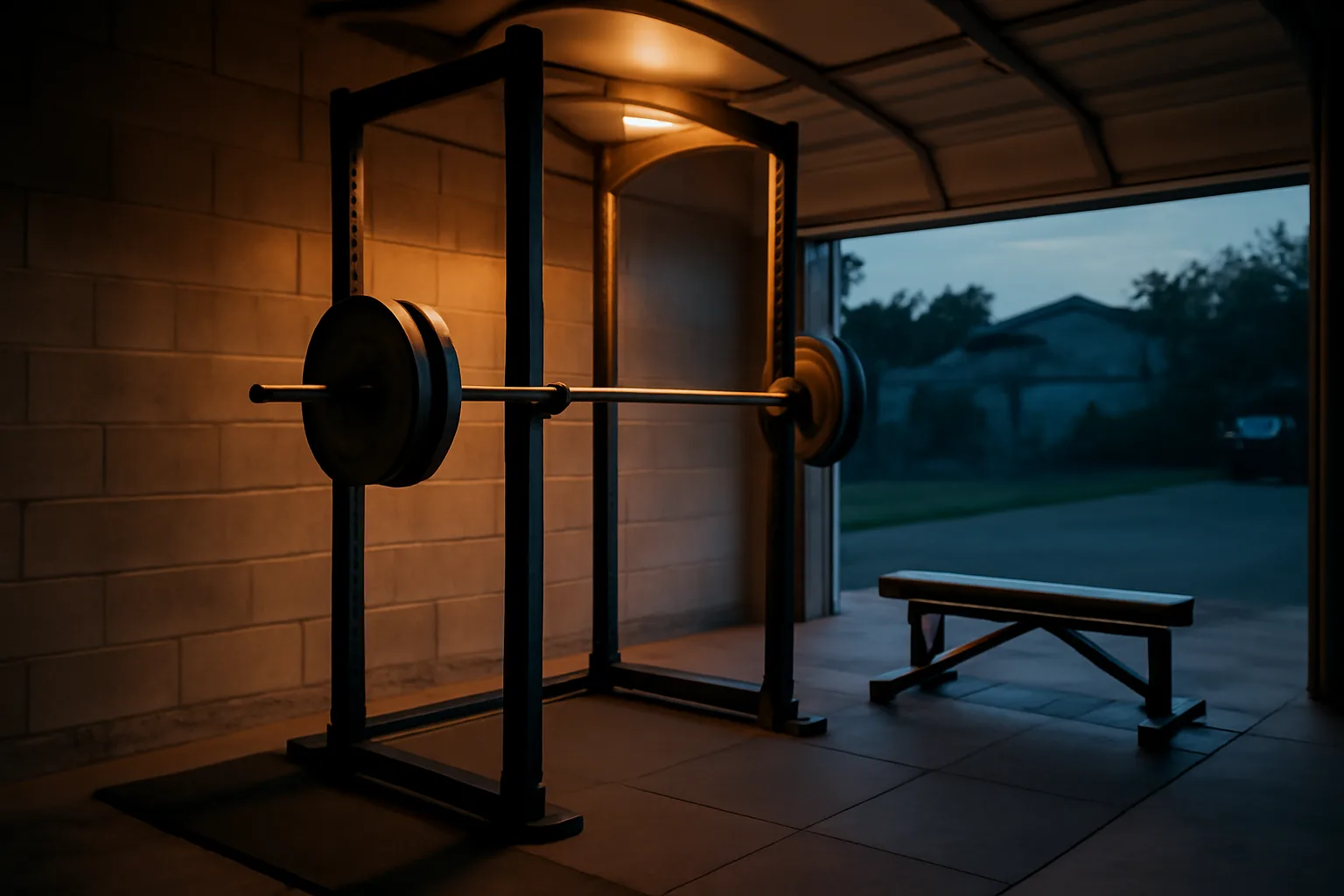
A power rack is a four-post steel cage, usually 4 feet by 4 feet or so in footprint, with adjustable J-hooks (the arms that hold the bar at rack height) and adjustable safety bars or straps set below your lowest lift position. You load a barbell onto the J-hooks, unrack it, do your squat, bench, or overhead press, and if you fail, the bar drops onto the safeties instead of onto you. That safety feature is the entire point. Squatting or benching heavy alone without a rack (or a spotter) is how people get pinned under a bar. A rack with correctly set safety pins removes that risk almost entirely, which is why it's the single piece of equipment trainers and strength coaches recommend first for a home setup. Most racks also have holes drilled along the uprights for a pull-up bar, and many accept add-on attachments: a lat pulldown/low row pulley, dip bar attachments, a landmine post, band pegs. That modularity is why one rack can replace three or four separate machines in a smaller room. For a deeper comparison of rack styles and what to look for, see our squat rack guide.
what is the best power rack for a home gym
There's no single "best" rack, because the right one depends on ceiling height, floor space, and whether you want pull-up capability and pulley attachments built in. But there are real specs to check before you buy anything. Look at these in order: footprint (do you have the clearance, including room to walk around the back for setup), uprights gauge and hole spacing (11-gauge steel is standard for home use, and 1-inch or 2-inch hole spacing changes how finely you can adjust J-hook height), weight capacity (most home racks are rated between 700 and 1,500 lbs static load, which is more than enough for nearly all lifters but worth confirming against the manufacturer spec sheet), and whether it's a full cage (four posts) versus a half rack (two posts, less enclosed, sometimes better for tight rooms). For most homeowners, a full power rack with a pull-up bar, adjustable J-hooks, and safety straps (more than pins) covers squat, bench, overhead press, and rack pulls in one footprint. If your ceiling is under 7.5 feet, measure carefully: many racks with a pull-up bar need 7 to 8 feet of clearance minimum, and you'll want extra room for the bar path on an overhead press. This is exactly the kind of measurement error a proper on-site plan catches before you've bought steel that doesn't fit. That's the whole reason a real design consultation includes an on-site measure and a 3D room plan before anything gets ordered, more than a tape measure and a guess.
how to use a power rack for squats
Set the J-hooks first. Stand next to the rack and set the hooks at a height where the bar sits just below shoulder height when you're standing (roughly mid-chest to collarbone height for most people). You should be able to step under the bar, get your shoulders under it, and stand up slightly to unrack it, not squat up from below or reach onto your toes. Set the safety bars or straps next. Do a bodyweight squat to your working depth inside the rack and set the safeties just below where your hips sit at the bottom of that squat, close enough that a failed rep drops only an inch or two before catching, not a full foot. Then: unrack the bar by standing it up and stepping back one or two steps, no more. Set your foot position, brace, and squat to depth, then drive back up. Re-rack by walking forward until the bar contacts the uprights and guiding the hooks under it, don't try to drop it in from a step away. A few real safety notes worth knowing here rather than guessing at: the U.S. Consumer Product Safety Commission's NEISS-based reporting on home exercise equipment incidents shows injuries are frequently linked to improper assembly, unstable placement, or use without adequate clearance around the equipment [1]. The Centers for Disease Control and Prevention's National Center for Health Statistics maintains the underlying NEISS-AIP dataset that CPSC and independent researchers use to track these exercise equipment injury patterns nationally [2]. ASTM International publishes a specific safety specification for strength equipment, ASTM F3105, covering externally loaded strength training equipment, benches, and weight storage, which is the standard most reputable rack manufacturers build to [3]. If you're new to barbell training, working with a qualified strength coach or certified personal trainer for your first several sessions is worth the cost, this article and this brand aren't a substitute for coached instruction on bar path, bracing, or depth.
how to choose the best gym equipment for home
| Power rack (rack only) | $300 to $1,500 | Squat, bench, press, pull-ups | 4x4 ft footprint, 7 to 8 ft ceiling | |
|---|---|---|---|---|
| Olympic barbell + plates (300 lb set) | $300 to $900 | All barbell lifts | Storage for bar + plates | |
| Adjustable bench | $150 to $600 | Bench press, rows, step-ups | 2x5 ft when in use | |
| Cable pulley system (rack-mounted) | $200 to $800 | Lat pulldowns, cable rows, curls | Attaches to existing rack | |
| Dumbbell set (adjustable, 5 to 50 lb per side) | $300 to $700 | Unilateral work, accessories | Small stand or rack | |
| Single-purpose machine (leg press, leg extension) | $800 to $3,000+ | Isolated joint work | Large dedicated footprint | The honest take: single-purpose machines are the most expensive per exercise they enable and the hardest to justify in a home gym unless you have a dedicated room and a specific reason (a physical therapist's recommendation, a specific sport need, genuine preference after years of training). For most people building their first serious home setup, a rack plus free weights covers 90% of useful training. See our full home gym equipment and gym equipment guides for deeper category breakdowns, and our best home gym equipment picks if you want specific product direction. |
Start from what you'll actually do three times a week, not what looks impressive. The order most strength coaches and home gym builders land on, in priority: a rack, a barbell and plates, a flat/adjustable bench, then dumbbells or a cable/pulley system. Everything past that (specialty bars, machines, cardio equipment) is a "nice to have" once the basics are dialed in. Here's a rough comparison of the main equipment categories, what they cost, and what they're actually good for: | Equipment type | Typical cost range | Best for | Space needed |
how much weight should i have for a home gym
For a barbell setup, plan on at least 300 lbs of plates plus a 45 lb Olympic bar as a starting point; that combination (roughly 345 lbs total loadable weight) covers squats, deadlifts, and presses for most beginner and intermediate lifters for a year or more of progression. Stronger or more experienced lifters, especially anyone doing deadlifts or squats seriously, often outgrow 300 lbs of plates within 12 to 18 months and add another 100 to 200 lbs of plates later. For dumbbells, a range from 5 lbs up to 50 or 60 lbs per hand (either as fixed pairs or an adjustable dumbbell system) covers most accessory and unilateral work. If budget or space is the constraint, adjustable dumbbells that load from roughly 5 to 50 lbs per side in one compact unit solve the storage problem, though they're slower to change between sets than fixed pairs. The honest answer nobody likes: there's no universal number, because it depends entirely on your current strength and how fast you plan to progress. A better rule is to buy enough plates to cover your current working weight plus 50%, and plan to add more later rather than overbuying up front. Racks and floor space are the harder constraint to change after the fact; plates you can always add.
how to build a home gym (step by step)
Building a home gym is a sequence, not a shopping trip. Skipping steps is how people end up with equipment that doesn't fit the room or a floor that can't handle it. 1. Pick the room and measure it. Garage, basement, spare bedroom, all work, but ceiling height, door width (for getting equipment in), and floor type all constrain what you can install. A rack with a pull-up bar typically needs 7.5 to 8+ feet of clearance. 2. Check the floor's load capacity. Under the 2021 International Residential Code, typical habitable rooms are designed for a minimum uniformly distributed live load of 40 pounds per square foot, while sleeping rooms are commonly rated at 30 psf; these are code minimums for general use, not guarantees for concentrated point loads like a loaded rack or repeated dropped-weight impact [4]. A stacked plate tree, a loaded rack, or dropped deadlifts create very different loading than someone standing on the same square foot. If you're unsure whether your basement or upper-floor room can handle a serious rack and plate load, have a structural engineer check it before you build, this is not a step to guess through. 3. Sort out flooring. Rubber gym flooring (typically 3/8 inch to 3/4 inch thick, sometimes thicker under lifting platforms) protects both the slab and the equipment from dropped-weight impact, which is a different load case than static weight sitting still. 4. Choose your core equipment: rack, bar, plates, bench, at minimum. 5. Plan power and lighting if you're finishing an unfinished space, garages and basements often need added outlets or better lighting before they're usable for training. The National Electrical Code (NFPA 70) governs circuit and receptacle requirements for these spaces, and a licensed electrician should pull permits where required by your local jurisdiction [5]. 6. Install, load-test cautiously, and add accessories over time. If you'd rather not run this sequence yourself, a design consultation covers the room assessment and equipment plan in one visit; you can book a design consultation to get an on-site measure and 3D layout before you commit to any equipment.
how to create a home gym in a small space
Small spaces (a one-car garage bay, a basement corner, a spare bedroom) need equipment chosen for footprint first, capability second. A folding or wall-mounted rack, a bench that stores vertically, and plates on a compact tree can fit a serious strength training setup into 6 feet by 8 feet, less than most people assume. The trick in small rooms is picking multi-use equipment over single-purpose gear. A rack with a pulley attachment replaces a separate cable machine. An adjustable bench replaces a flat bench, an incline bench, and a decline bench. A single loadable barbell and plate set replaces most of what a machine circuit would otherwise cover. Ceiling height matters more in small rooms because there's less room to compromise elsewhere: a pull-up bar mounted on a rack needs the same 7 to 8 feet of clearance in a small room as a large one, so if your ceiling is lower than that, look at wall-mounted or fold-away pull-up options instead of assuming the rack simply won't fit. For room-specific layout advice, our home gym guide covers small-space floor plans in more depth, and if a single multi-station machine is genuinely a better fit for your footprint than a rack (some very tight rooms do better with one compact machine than a rack plus loose plates), our gym machine at home guide walks through that option.
how much does a home gym cost
A basic setup (rack, bar, plates, bench) runs $1,000 to $2,500 in equipment alone if you're buying mid-range gear rather than the cheapest available. A fuller setup with a cable pulley attachment, an adjustable bench, dumbbells, and flooring lands more commonly in the $3,000 to $6,000 range. Add cardio equipment (a treadmill or rower) and you're looking at another $1,000 to $3,000 depending on quality. Those numbers are equipment only. A turnkey build, meaning the room is finished, wired, lit, floored, and the equipment installed as one project, costs more because it includes labor, electrical work, flooring installation, and often drywall or insulation if you're converting a garage or unfinished basement. That total varies enormously by region, room condition, and finish level, there's no honest single number to quote here without seeing the space, which is exactly why a fixed quote follows an on-site measure rather than a generic price list. A sensible way to plan a budget: separate equipment cost (which you can shop and compare directly) from room cost (electrical, flooring, lighting, HVAC), and price them separately before you commit to either. See our budgeting guidance if your site has a dedicated cost breakdown hub, or talk through both sides in a single design consultation.
how to make a home gym without a dedicated room
You don't need a spare room to have a real home gym. A rack that folds flat against a wall when not in use, a bench that stores upright, and plates on a vertical tree can share a garage bay, a laundry room corner, or even a wide hallway. The compromise with fold-away equipment is setup time and slightly reduced rigidity compared to a permanently bolted rack, but for someone training in a shared or multi-use space, that trade is usually worth it. Look specifically for racks rated for wall-mounting with a documented weight capacity, and check the manufacturer's mounting instructions for stud spacing and anchor type before installing. If the space genuinely can't fit a rack at all, a single well-chosen machine, a functional trainer or compact multi-gym with a stack of adjustable resistance, can cover a surprising amount of a full-body program in one footprint. It won't replace a barbell for raw strength work, but for general fitness maintenance in under 20 square feet, it's a real option. Our gym machine at home guide covers what to look for in that category specifically.
diy home gym: what to do yourself and what to have professionally done
A DIY home gym works well for equipment selection, assembly, and layout in a room that's already finished, has adequate power, and sits on a slab or a floor you already know can take the load. Assembling a rack, setting up a bench, and arranging plates is well within reach for most people with basic tools and an afternoon. Where DIY gets risky is the structural and electrical side: cutting into drywall, adding circuits, verifying floor load capacity on an upper story or over an unfinished basement, and pouring or reinforcing a slab. Those aren't jobs to guess through, a licensed electrician and, where the floor load is in question, a structural engineer should sign off before you load a rack and 400+ lbs of plates onto a floor you're not sure about. The honest middle ground: DIY the equipment and layout, hire out anything structural or electrical, and if you want the whole thing planned and executed as one project rather than juggling contractors yourself, that's what a design-and-build service is for. A single fixed quote after an on-site measure means you know the full cost, room work and equipment install together, before anything starts. Book a design consultation if you'd rather have the room measured and planned professionally than guess at it yourself.
Frequently asked questions
How much weight should I have for a home gym?
Most lifters start with a 45 lb barbell plus 300 lbs of plates, roughly 345 lbs total, which covers a beginner-to-intermediate lifter for a year or more. Stronger lifters, especially those deadlifting or squatting seriously, often add another 100 to 200 lbs within 12 to 18 months. Buy for your current working weight plus about 50%, then add plates later rather than overbuying up front.
How much does a home gym cost?
A basic rack-and-barbell setup runs $1,000 to $2,500 in equipment. A fuller setup with pulleys, a bench, dumbbells, and flooring lands around $3,000 to $6,000. Turnkey builds that include electrical, flooring, and installation cost more and vary widely by room condition and region, which is why a fixed quote follows an on-site measure rather than a flat number.
How do I build a home gym from scratch?
Pick and measure the room, confirm the floor can handle the load (check with a structural engineer if unsure), sort out flooring, choose core equipment (rack, bar, plates, bench), address power and lighting if needed, then install and add accessories over time. Skipping the floor check is the most common costly mistake.
What is a power rack and do I actually need one?
A power rack is a four-post steel cage with adjustable arms that hold a barbell and adjustable safety bars that catch a failed lift. If you plan to squat, bench, or press heavy without a spotter, yes, it's the single piece of equipment strength coaches recommend first because it removes most of the risk of lifting alone.
What is the best power rack for a home gym?
There's no single best rack; it depends on your ceiling height, floor space, and whether you want pull-up and pulley attachments. Check footprint, steel gauge, hole spacing, and rated weight capacity (commonly 700 to 1,500 lbs for home units) before buying, and confirm ceiling clearance, most racks with a pull-up bar need 7 to 8+ feet.
How do I use a power rack for squats safely?
Set the J-hooks so the bar sits near shoulder height when standing, set the safety bars just below your squat depth, unrack by standing up and stepping back once or twice, squat to depth, then re-rack by walking the bar forward into the hooks. New lifters should get coached instruction on bracing and depth before loading up heavy.
How do I choose the best gym equipment for a home setup?
Prioritize equipment by what you'll use most often: a rack, barbell and plates, an adjustable bench, then dumbbells or a cable system. Single-purpose machines (leg press, leg extension) cost more per exercise enabled and take more space; add them last, if at all, once the basics are in place.
Can I build a home gym in a small space?
Yes. A folding or wall-mounted rack, an adjustable bench that stores vertically, and a compact plate tree can fit a real strength setup into roughly 6 by 8 feet. Multi-use equipment (one rack with a pulley attachment instead of separate machines) is the key to making a small footprint work.
Is a DIY home gym a good idea, or should I hire someone?
DIY works well for equipment assembly and layout in an already-finished room with known floor capacity. Hire a licensed electrician for added circuits and a structural engineer to verify floor load if you're unsure about a basement or upper-floor install. A design-and-build service can handle both the planning and the labor as one project.
Can my basement or upper floor actually hold a power rack and weights?
Maybe, but don't assume. Residential floors are commonly designed to a 40 psf live load minimum under the International Residential Code, with sleeping rooms sometimes lower at 30 psf; that's a general design minimum, not a guarantee against concentrated loads from a loaded rack or dropped weight impact. Have a structural engineer check any load-bearing question before installing.
What's the difference between a power rack and a smaller half rack?
A full power rack has four posts and fully encloses the lifter, generally offering more safety bar coverage and attachment points. A half rack has two posts, a smaller footprint, and works well in tighter rooms, but offers slightly less enclosure and fewer attachment options for pulleys or dip bars.
Do I need a spotter if I have a power rack?
A properly adjusted rack with safety bars or straps set close to your working depth removes most of the danger of lifting alone, since a failed rep drops only a short distance onto the safeties. It doesn't replace good coaching on technique, though, especially for new lifters learning bar path and bracing.
Sources
- U.S. Consumer Product Safety Commission, NEISS Injury Data System: CPSC tracks home exercise equipment injuries and links many to improper assembly, unstable placement, or inadequate clearance
- ASTM International, F3105 Standard Specification for Externally Loaded Strength Training Equipment: ASTM F3105 is the published safety specification covering externally loaded strength training equipment, strength training benches, and external weight storage
- International Code Council, 2021 International Residential Code, Table R301.5 Minimum Uniformly Distributed Live Loads: IRC Table R301.5 sets minimum live load design values of 40 psf for typical rooms and 30 psf for sleeping rooms
- Centers for Disease Control and Prevention, National Center for Health Statistics, NEISS-AIP data documentation: CDC/NCHS maintains the NEISS-AIP dataset used to track exercise equipment injury patterns nationally
- National Fire Protection Association, NFPA 70 National Electrical Code, Article 210 (Branch Circuits): NFPA 70 governs circuit and receptacle requirements for garage and basement electrical work in home gym conversions
- U.S. Bureau of Labor Statistics, Occupational Employment and Wage Statistics, Electricians (47-2111): Licensed electricians are the standard credentialed trade for adding circuits in garage or basement gym conversions